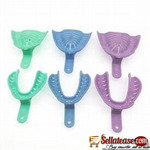
USES AND FEATURES OF IMPRESSION TRAYS Used to hold impression material Can be perforated for better retention Have a handle for better grasp during placement and removal Dentate impression trays – for patients with teeth Edentulous impression trays – for patients with no teeth
The primary use of dental photography is certainly to assist the operator on the initial examination of the patient, to help him in the diagnosis and control of the medical care outcome over time.
The goal is to place the dental implant according to where the final dental restoration will be fabricated. The precision, accuracy, and 3-dimensional visualization capabilities of these technologies open avenues for the oral and maxillofacial surgeon in the diagnosis, planning, and surgical management of many nonimplant-related cases.
Periodontal scalers are dental instruments used in the prophylactic and periodontal care of teeth (most often human teeth), including scaling and root planing. The working ends come in a variety of shapes and sizes, but they are always narrow at the tip, so as to allow for access to narrow embrasure spaces between teeth. They differ from periodontal curettes...
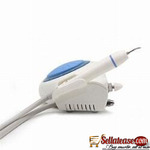
A tooth scaler is a tool that removes plaque, tartar, stains, bacteria, and debris from the tooth surface and under the gums. It can be a metal hand tool with a hook-shaped end or an electric device that uses ultrasound and water or mouthwash to blast and flush away the deposits. It can help keep the teeth and gums in optimal condition when used regularly al...
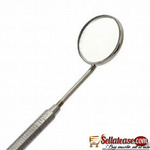
A mouth mirror or dentist's mirror is an instrument used in dentistry. The head of the mirror is usually round, and the most common sizes used are (⌀ 18 mm) and No. 5 (⌀ 20 mm). A No. is sometimes used when a smaller mirror is needed, such as when working on back teeth with a dental dam in place. The mouth mirror has a wide range of uses. Three of its most i...
Convex mirrors make things look smaller, but concave mirrors enlarge the pictures. The surface of a concave mirror becomes curved inward and outwardly. Concave mirrors are utilized by dentists because they are converging mirrors that reflect light to the focus point. Dentists can use this sort of mirror to see the tooth more clearly if there is an inflammati...
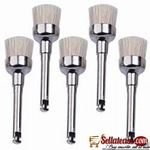
Bristle brushes are used in the prophylaxis angle with a polishing paste. The use of the brush should be confined to the crown to avoid injury to the gingiva and cementum. Prophy angle [ edit] Currently, the most commonly used tool for tooth polishing is prophy angle
A prophy brush, also known as a polishing brush, is a small fine-bristled brush mounted onto a low-speed handpiece and used in combination with an abrasive polishing paste to polish the surface of teeth or newly placed restorations, removing stains and fine irregularities and making the teeth's surfaces smooth.
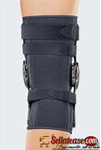
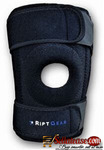
A knee brace is one tool in managing the discomfort of knee osteoarthritis. A brace might help reduce pain by shifting your weight off the most damaged portion of your knee. Wearing a brace can improve your ability to get around and help you walk farther comfortably.
A knee brace works by providing protection, compression, and stability in different levels: The protection helps healing after an injury and avoids making it worse. The compression provides support to the knee joint, a sense of stability, and some pain relief.
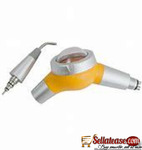
Conventional supragingival air polishing uses a combination of air, water, and abrasive powders. Indications for use include removal of biofilm and stain on enamel surfaces, and cleaning of pits and fissures prior to sealant placement.